


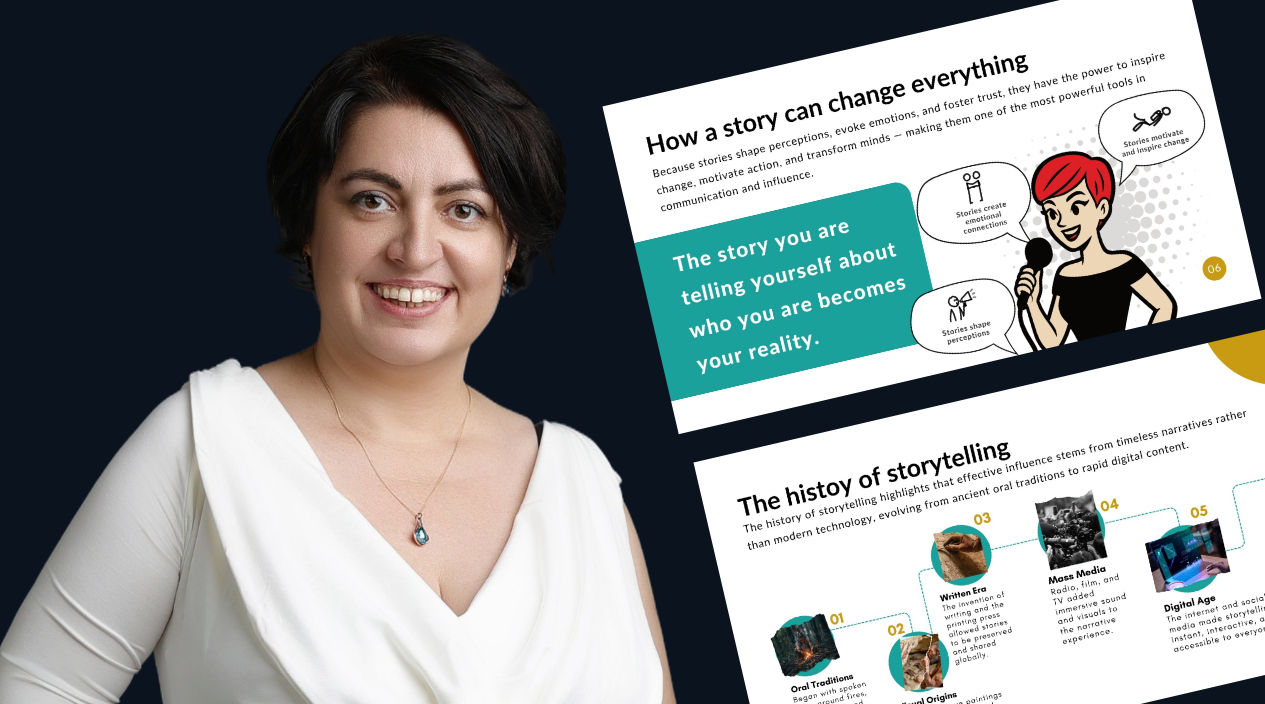
Discover four simple techniques to create your brand story. Choose what suits you.
I learned a lot about creating your brand story when I started my blog, participated in the Toastmasters group from my town, and the books I read about writing. I would be happy if my research and practice could bring you some light to tell your story.
In psychology, your life experiences are interpreted and create a personal story. And this story can block your development or help you. The problem is that some people create negative stories about themselves and what they deserve, making them unhappy, leading to mental illness, and limiting their potential. Few of us know that we can rewrite our life stories at any moment.
No one will see your greatness until you’re not seeing it.
Reassess your life experience and give it meaning based on your prevailing personality. Create two or three short stories of one minute to present yourself. Ask a friend if it feels: professional, entertaining, exciting, and connected to you with your account.
When it comes to personal stories, I like the four techniques that I will talk about.
1. The story circle
The first one is The story circle, adapted by Dan Harmon, the creator of the “Rick and Morty” show. For each episode, he presents the character in his comfort zone. The character wants something that will push him outside his familiar situation. He adapts to it, gets what he wants, pays the price for it, then returns to the standard position with a slight change.
So it is in life. We are neither perfect nor reach such a thing in life. Instead, we can improve our lives in small steps. Perfection does not connect us, and if you have reached your final goal and have no future ones, you cannot keep an audience that has more to find from you.
Let’s think about doing like in a TV show, create an audience captivated by us and our adventures, an audience that sees our imperfection and our ambition to change it, an audience that sees our struggles and victories.
Example:
Almost 5 years ago, I was working as a salesman. I wanted more, a job that would motivate me and make me really happy. And I started to learn during my free time (Excel, Photoshop, and Adobe Illustrator). I also signed up for a PR internship at an NGO. I lost my job and was scared that I didn’t deserve more than that, no matter how much I learned. But when I almost lost hope, I found a job as a graphic designer for offline products (brochures, business cards, posters, etc.). This was the first step in my new design career. And the adventures from going from offline to online.
2. The elevator technique.
It is a 30 seconds presentation about you. In which you answer: “What do you do?”.
- Level 1 – Tell who you are (your name).
- Level 2 – Tell a brief background of your education.
- Level 3 – Explain and provide the context of why you are here.
- Level 4 – Create a connection by telling them what you can do for them.
- Level 5- Ask what you want from them.
- Level 6 – Closeout pleasant. I think this technique is suitable for interviews.
Example:
I’m Andreea, a UX-UI designer. I like to share my knowledge to create more outstanding products and teams. For example, I did courses, events, and kits for new designers. And I have studied psychology, UX UI design, and branding design. You can find more about me on my portfolio website and Linkedin profile. Here is my business card. Thank you.
3.The S.N.A.A.P. technique.
Super Networking at Accelerated Pace.
A 60-120 seconds presentation.
First, speak about your result. Talk about what you offer. Second, talk about what it’s for your audience (benefits). And always end with a question (if they can help you or know someone interested in what you can offer).
Example:
I’m helping people by bringing out their qualities and potential. As a result of using the information from the Course “Personal branding masterclass,” you can highlight your skills and reach the right audience for you. I’m looking for individuals interested in stepping out of anonymity and making the change they want by creating an impactful personal brand. Who do you know is interested in this?
4. The deep technique.
A story that connects you faster with your audience.
You can help a person climb the ladder of success if you show your process; he is not the only one with those thoughts, feelings, and struggles. Talk about who you are today. What you went through to get here. And then talk about your mission, values, and lessons you learned in life.
This technique is good when you want to create an emotional connection.
Example:
Today I’m designing websites, mobile apps and creating brands. And I’m writing a self-development blog and working to become financially independent.
My life wasn’t easy. I struggled to find a job and be happy with what I did. Thankfully I learned to say what I have in my mind, not to demoralize myself, and to continue learning and working. I have learned to trust my imagination, and I want to use all these abilities to create a better world.
These are the four techniques I recommend. You can also use this checklist if you still find it difficult to form your brand story. I also recommend my brand story course.
Checklist – To create more stories:
- Start by defining your purpose. Decide what you want your story to achieve.
- Do you want to inspire, entertain, inform, or influence behavior and beliefs?
- Clarity of purpose keeps your story focused and impactful.
- Follow a simple structure: introduction (15%), content (70%), and resolution (15%).
- Maintain this balance to keep the audience engaged from start to finish.
- Show vulnerability. Perfect characters feel distant, while flaws make people relatable.
- Share your challenges and lessons alongside achievements. Honesty always builds stronger connections.
- Keep your story audience‑focused. Your goal is to serve and help, not to seek validation.
- Position yourself as a guide who solves the audience’s problems using your expertise.
- Invite participation. Let listeners feel involved in your success.
- Add sensory details—sounds, colors, and emotions—that bring your story to life.
- Study others. Collect impactful stories, quotes, and biographies.
- Analyze what moves you and apply similar principles when shaping your narrative.
- Stay specific, authentic, and transparent.
- End with a clear call to action—encourage feedback, sharing, or reflection.
- Choose the story type that fits your message.
- Tell an origin story to explain your “why,” a growth story to show evolution, or a transformational story to mark change.
- Show, don’t just tell.
- Use gestures, pauses, tone, and energy to communicate emotion physically.
- Add stories even when presenting data. People remember stories better than raw facts.
- A well‑told story lets your audience experience life through your perspective.
- Create movement and anticipation in your story. Avoid static statements that lose attention.
- Use personal experience that shaped you deeply. Focus on emotional connection, not unnecessary details.
- Be passionate, honest, and proud of your imperfections.
- Test your story with trusted friends for feedback.
- Finally, discover your unique voice. Communicate in a style authentic to your personality and values.
You can also use the free resources to improve your storytelling ability.
Was the information helpful to you? Leave me your opinion in a comment.