


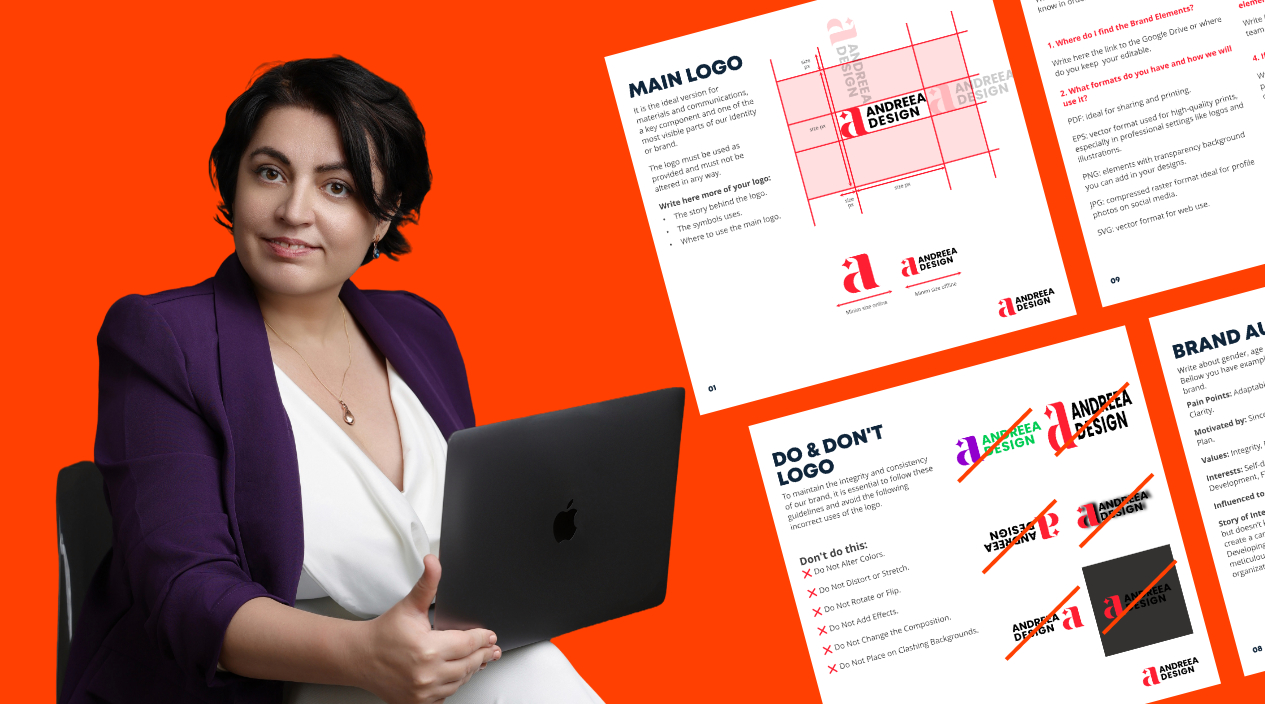
Discover how you can create your brand to help more people.
But first, we should know why we need a personal brand.
Your brand is your most unique asset and the most powerful tool that you could use to: change your career, become an influencer in your field, make an impact, create better connections and promote yourself.
Everyone has a personal brand, whether or not they care about it. In any interaction with others, we create an image about ourselves, and when we act consciously and know what we want to be and attract in our lives, we have more control over what we reflect.
Be more authentic, unique, trustworthy, and memorable, and create an impact. And you’ll resonate with your audience better, people will recognize you faster, attract genuine clients for your product or service, achieve more of your goals, and work with a purpose.
How can we understand what a personal brand is?
I found The brand gap by Martin Neumeier the closest to reality representation of what it is.
Let’s say a woman and a man meet. When he’s saying, I’m a great lover, that’s marketing.
When two girls meet and speak about the man and say He’s a great lover, it is a public relationship.
That’s a commercial. When the man repeats the same message, I’m a great lover.
When we use symbols to represent what we want to say, that’s design.
But when the woman that meets a man says I understand that you’re a great lover, that’s branding. Because it’s about how people see you.
The unique combination of your skills, experience, personality, story, behavior, attitudes, and message creates a more potent and prolonged connection with the world. Everyone has a personal brand. The question is whether or not you take care of it.
A personal brand contains:
- Your vision, mission, values & personal story.
- Your abilities, competence & experience.
- Behaviour & relationship with others.
- Reputation & networking.
- Image & identity (how you dress, how you act, what you say, graphic elements, website, etc.).
- Measurable objectives (KPI).
To understand your brand, you must answer the question:
- Who am I?
- Who needs to know?
- How will they find out?
- Why should they care?
Imagine that you must climb a ladder to create your brand. You have to answer seven questions to develop your brand:
- Who am I?
- What can I do and offer to the world?
- The audience, How can they find me?
- Why would they choose me?
- How to promote my brand
- How do I grow my network?
- Can I improve my experience?
I’ll take them one at a time.
1. Who am I?
Jean-Paul Sartre, a philosopher, says: We are beings with self-awareness, and we have the power to give ourselves a sense of self; through this meaning, we create our lives.
I think we are creative people, and if we do not have a mission of our own, we bring to life the wishes and visions of other people.
Here are some questions that will help you answer this question. I know these are challenging questions, but they are worth it because by knowing who you are, you identify your mission and values and understand what kind of people you want to attract.
List of questions to know yourself better:
- What do you value or appreciate most about yourself or others?
- What do you want from life?
- What are your talents and abilities?
- What do you admire most about others? And what do you not?
- What are your strengths and weaknesses?
- What are your most important objectives?
- What would you like to change about yourself?
- What things have you learned in life?
- What would you like to be / to do / to see / to feel / to know?
- How satisfied are you with your person, your health, your relationships, the money you have, your career, your skills, and your possessions? And what can you do to change what you don’t like?
- What life stories do you have from which others can learn something?
- What would you like to leave to your loved ones after your death?
2. What can I do and offer to the world as a personal brand?
I tried to find this answer myself, and the most complete I found was when reading IKIGAI by Francesc Miralles and Hector Garcia. It is a great book that I recommend.
IKIGAI in Japanese means the meaning of life. These authors traveled to Japan and interviewed the most longevity people about what made them leave so much and be healthy (mentally and physically). The answer is: follow your IKIGAI. This is a combination of things you like to do, and you are good at something you can be paid for, and things the world needs. Your IKIGAI can change, but if you follow it, your work will give you the most satisfaction and offer the most valued world work.
The answer to this question is different, but that does not mean it is wrong. Each has its mission in life, and some of us can intersect in creating our missions.
3. Finding my audience as a personal brand.
Most of my clients, when I ask them who their audience is, they tell me that it is everyone. Sometimes it gets tiring to repeat that it is not everyone, your products are bought by those interested in them, and if you do not speak for your audience, you will never win them.
If you want to make an impact, you have to identify your audience well.
Create 2-3 fictive portraits for your audience to help you think of how to interact with them.
What it contains a Persona Portrait?
- A picture
- Name
- Occupation
- Location
- Household income
- Net worth
- Age
- Politically orientation
- Family status
- Gender
- Hobbies & interests
- Personality traits
- Buying habits
- They’re Quote
- The needs, problems & opportunity
- What social media platform do they use?
- What interests and what motivates them?
- What can influence them to buy or to remain faithful to a brand?
Let’s find out who’s your audience:
- those who want an easy life (to find from you secrets that can make their life easier);
- those who want to make a good impression by having reliable and trustworthy information resources;
- those who want an emotional connection with your brand story and with people like them;
- those who want to be inspired;
- those who want to say their opinion, to have conversations with real people;
- those who appreciate quality things and know their value;
- those who want to be entertained;
- the future boss or collaborator of you;
- those who want concise and clear information;
- those who wish to have the same career as you;
- those who are looking for answers that you have and those who want to be part of a community.
Now that you know your audience, you know what to offer them.
4. Why would they choose me?
In his book Start with Why, Simon Sinek discusses the things that create genuine connections., your purpose or your cause. This is why people would choose you instead of the competition.
Most of us don’t talk about why we do what they do. Companies talk about how they’re doing, the process, and what they offer (products or services). The thing is that people don’t make rational decisions. They make emotional decisions. I’m not buying a purse because I need a bag. I need to have something where to keep my essential things. I need something practical or something to receive a compliment, something to feel more confident in my femininity, something to show my value, something to light my day, and maybe not feel guilty about thinking of me.
Someone who will tell me If I need a purse we have purses, will not convince me to buy. What will make me buy is if you can offer me the why, the story behind your product, and the emotional thing you’ll satisfy. I’m not interested in your product. I’m interested in what it can give me. So start with the why when you speak about you, your services, or your products.
5. How can I promote my personal brand?
Offline: business cards, flyers, posters, portfolio, pins, products created by you, etc.
Be active: go to events and courses and meet new people, and be involved in groups like Quora, Reddit, Medium, Tumblr, etc. you can choose your groups depending on your interests, create blogs, participate on social platforms, forums, etc.
Make online content: books, courses, and sites. Create your pages on LinkedIn, YouTube, Twitter, Facebook, Pinterest, Instagram, and Snapchat, depending on where your audience is.
Create your opportunities: create your events, speak with influential people, ask for job opportunities, ask for opinions on what you are doing, build your fan group, etc. When I wanted to create a quilling course for children, I did not wait for others to ask me. I walked to hobby shops and asked if they were interested in collaborating with me. When I wanted to be a web designer, my boss didn’t search for a web designer because he was the only designer in his company, but I talked to him about having time for more things and having someone to help him. If there is no door, you create one to have what to open.
This is what you learn when you reach the next level of promotion. See, people don’t see greatness in you till you’re not seeing it.
6. How do I grow my network?
Get out of your bubble. And here, a whole world awaits you to show your vision. Show what you’re working at. And show what you love about your field. Show your human side. Show the values that drive you. The thing is that people will not discover you till you’re not opening.
Reach your audience at events, on social platforms, and in other places frequented by them.
7. How to improve your abilities?
Create your career road using these questions:
- What exactly do I want?
- What skills and diplomas do I need?
- What do people who already work in this field know? How can I learn from them or enter an internship?
- What new contributions could I make in my chosen field?
- What can I do to develop my experience in the area?
- What objectives can I set for myself, something measurable with a deadline?
8. How do I improve the experience?
Choose a Mentor and Build Your Growth Path
Choosing a mentor can transform your professional journey. A mentor has already traveled the road you are beginning now. Their experience helps you avoid mistakes, stay focused, and accelerate growth through shared wisdom and guidance.
Visualize and Believe in Success
Create a dream board to visualize your goals and inspire daily motivation. Visual imagery turns intentions into reality and keeps you committed. For example, placing images of achievements or dreams reminds you what you are working for. Personally, I added a picture of someone performing on stage. I gained confidence and later performed in a stage play. I also visualized learning to ride a bike and accomplished it. Visualization strengthens belief and directs energy toward results.
Track Your Personal Development
Keep a personal development journal to document your journey. Write your goals, reflections, and lessons learned from each experience. Note what worked well and what can improve next time. Include motivational quotes, gratitude entries, and daily wins. Journaling helps maintain focus, clarity, and consistency while fostering continuous self‑awareness.
Expand Your Skills and Network
Join communities that share your interests. Surrounding yourself with like‑minded individuals fosters encouragement, accountability, and inspiration. Furthermore, try new activities to build confidence and creativity. I explored Qigong for back health, acting, drawing, and public speaking. Each experience expanded my imagination, discipline, and self‑understanding. We are not born with all the abilities we need, but lifelong learning helps unlock them.
Empower Yourself and Others
Growth becomes more meaningful when you also lift others. Share your knowledge and encourage peers to reach their potential alongside you. Personal development and branding go hand in hand—you evolve, connect, and contribute simultaneously.
If you want to deepen this process, explore my branding course, where you can learn structured steps to define and strengthen your unique brand. I also recommend the free resources to improve your brand design.